Karel Miler 1940–2025
/4
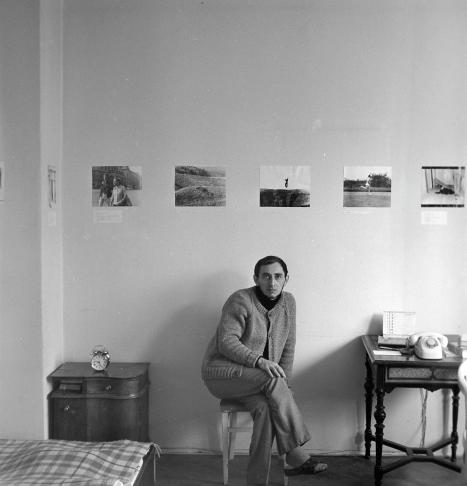
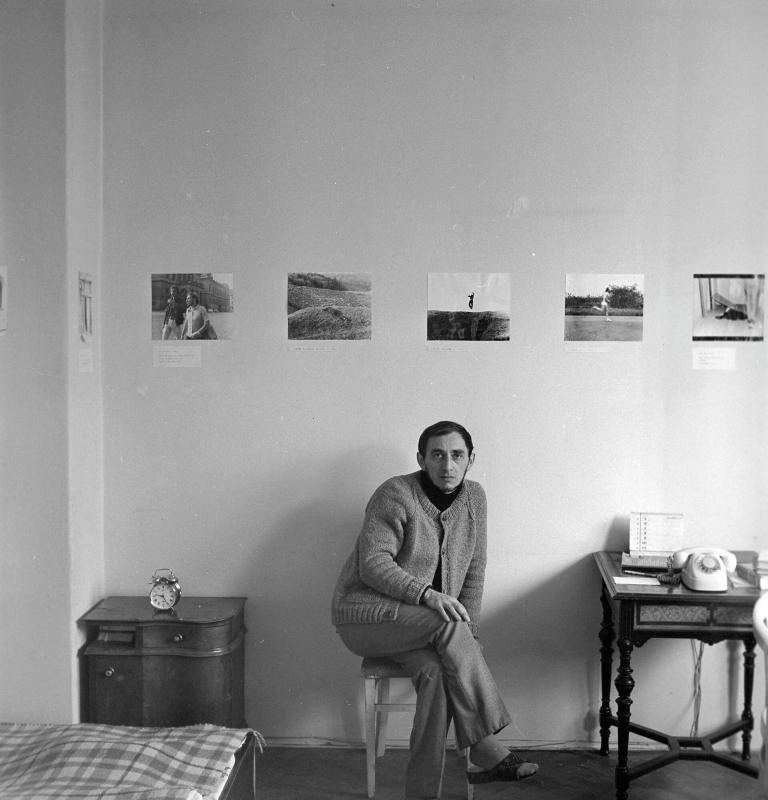
The Czech conceptual artist Karel Miler repeatedly rejected existential interpretations of his works. He instead tended to view his oeuvre as a search for elementary relationships much like those investigated by artists such as the American minimalists. Even so, he responded to an April 1979 request to define recent changes in contemporary art for a contribution to a semi-clandestine catalogue by stating that “today, art has become a private matter. In the same sense in which death is one.” Art’s becoming a private matter for Miler was owed to the fact that he had himself become involved in it—as an art history graduate employed as a collections and preservation administrator at the National Gallery in Prague—through reading imported magazines. Even though his visual poetry from around 1970 had already queried elementary structures of communication, it was only in his first performance action—entitled "Either – Or" (1972)—that the elementary polarities evoked by the work’s title were expressed by means of the artist’s own body. The private character of Miler’s performance art remained present in his subsequent works: unlike his colleagues Petr Štembera and Jan Mlčoch, whose performances typically took place before an audience or even in direct collaboration with spectators, Miler at first performed exclusively in front of a camera—with only the photographic documentation actually intended to be seen by an audience. Likewise private was Miler’s unique solo exhibition that was arranged at the end of 1977 by the phenomenological thinker Petr Rezek, who had taken an interest in contemporary conceptual art at that time and hosted this exhibition at his own apartment.
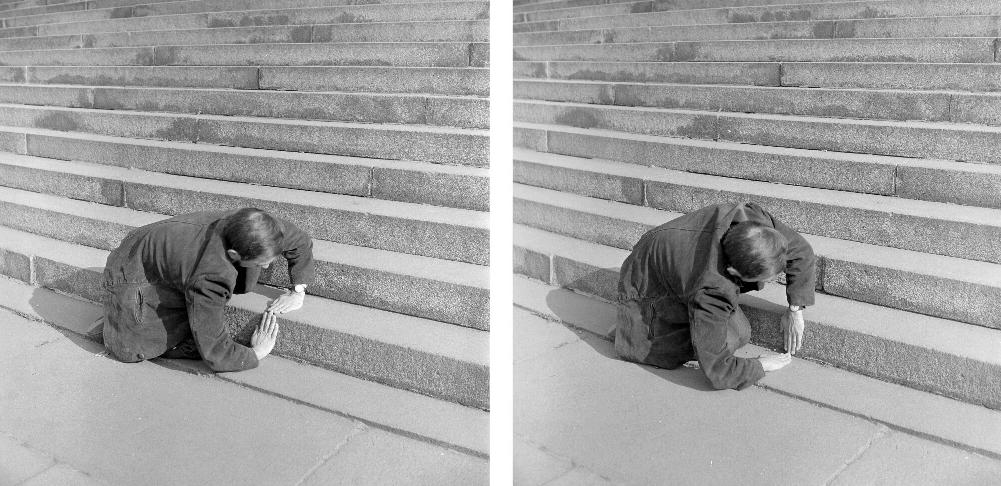
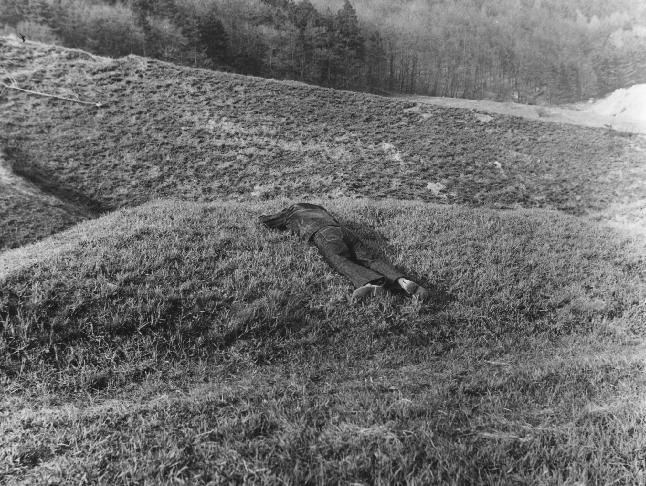
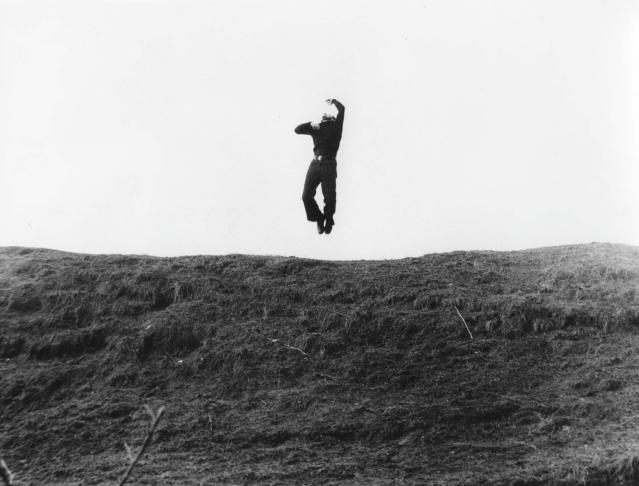
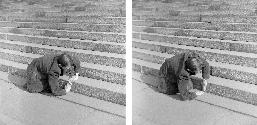
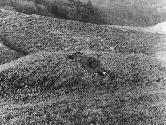
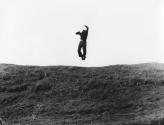
The 1972 work "Either – Or" consists of two photographs: one shows Miler lying on the road with his face to the ground, whereas the other shows him lying on the curb. In this way, the artist used a simple gesture to thematize the fundamental options of human corporeality in its relationship to a chosen space. The same can be said of other works from this period such as "Measuring" (1974), "Paper" (1975), or "Disclosing the River" (1975). Measuring consists of two photographs depicting the artist as he measures out steps using the flats of his hands; in Paper, three shots document the artist as he shovels paper scraps into a corner at the foot of a stone bridge balustrade; and in Disclosing the River, comprised of four photographs, we first observe an empty river bank, then the artist as he plunges his hand into the soil at the bank, then the artist washing his hand in the river, and finally the empty river bank once again with only a few wet traces remaining from the performance. The difference in the numbers of photographs corresponds to the differing characters of the respective actions: whereas two photographs show binary opposites, three and four shots manifest sequences of motions—with the distinction that four shots also allow us to see the situation before and after the action itself. The procedures employed by Miler in the early 1970s—i.e., the photographic series and/or the photographic sequence—correspond to his interest in the analytic investigation of a chosen model situation, whereas the late 1970s saw the artist switch almost entirely to presenting a given action in a single photograph. This is also evident in the surviving photographs of the abovementioned exhibition’s installation in the apartment of the philosopher Rezek—where the closely grouped sequences of two, three, and four pictures are followed by the chronologically ordered single photographs of the actions Sensed by "Fresh Grass" (1976), "Closer to Clouds" (1977), and "Holy I" (1977) with identical gaps in between. These last-mentioned actions, instead of recording sequences of events, evoke experience—manifested either as sensing one’s own body (such as when the artist had himself documented while attempting to jump as close to the clouds as possible or while running) or as allowing one’s body to be sensed (such as by the grass on which he stretches out).
The unifying element of these (otherwise quite distinct) performances from the early and late 1970s is that they capture the artist’s body as something individualized, isolated from its surroundings, indeed even crouching—sometimes in a corner. This is particularly conspicuous in the photographs of performances that took place in urban environments, images that show the artist kneeling with his head turned to the ground. On the one hand, these pictures could confirm Miler’s statement asserting his performances’ model character—bereft of all internal/existential or external/political connotations. However, the crouching stance and downturned face also invite an existential interpretation, suggested at the time by Rezek, seeing as the self-absorption we perceive in Miler’s performances can also be interpreted as a reduction of one’s own self to the pure presence of one’s body along with the loss of free rapport with things and the forfeiture of any openness to the world. According to Rezek, however, the pure presence of the body manifests infinite interpersonal distance in simultaneous corporeal proximity, where “the distance that comes to be voiced in this kind of proximity is death, and we have no way whatsoever to ‘respond to’ death, even though it is always nearby: proximity-in-distance is a life which is occurring right at the moment while stretching all the way to where life has its end.” Hence, if Miler claims that art had become a private matter in 1970s Czechoslovakia, Rezek adds that precisely this private character of then-contemporary art allows for a genuine encounter with one’s own finitude.
Karel Miler passed away in Prague on 29 December 2025.
Karel Císař
Karel Císař is Professor and Head of the Department of Theory and History of Art at the Academy of Arts, Architecture and Design in Prague.
Translation: Martin Pokorný
March 2026
The 1972 work "Either – Or" consists of two photographs: one shows Miler lying on the road with his face to the ground, whereas the other shows him lying on the curb. In this way, the artist used a simple gesture to thematize the fundamental options of human corporeality in its relationship to a chosen space. The same can be said of other works from this period such as "Measuring" (1974), "Paper" (1975), or "Disclosing the River" (1975). Measuring consists of two photographs depicting the artist as he measures out steps using the flats of his hands; in Paper, three shots document the artist as he shovels paper scraps into a corner at the foot of a stone bridge balustrade; and in Disclosing the River, comprised of four photographs, we first observe an empty river bank, then the artist as he plunges his hand into the soil at the bank, then the artist washing his hand in the river, and finally the empty river bank once again with only a few wet traces remaining from the performance. The difference in the numbers of photographs corresponds to the differing characters of the respective actions: whereas two photographs show binary opposites, three and four shots manifest sequences of motions—with the distinction that four shots also allow us to see the situation before and after the action itself. The procedures employed by Miler in the early 1970s—i.e., the photographic series and/or the photographic sequence—correspond to his interest in the analytic investigation of a chosen model situation, whereas the late 1970s saw the artist switch almost entirely to presenting a given action in a single photograph. This is also evident in the surviving photographs of the abovementioned exhibition’s installation in the apartment of the philosopher Rezek—where the closely grouped sequences of two, three, and four pictures are followed by the chronologically ordered single photographs of the actions Sensed by "Fresh Grass" (1976), "Closer to Clouds" (1977), and "Holy I" (1977) with identical gaps in between. These last-mentioned actions, instead of recording sequences of events, evoke experience—manifested either as sensing one’s own body (such as when the artist had himself documented while attempting to jump as close to the clouds as possible or while running) or as allowing one’s body to be sensed (such as by the grass on which he stretches out).
The unifying element of these (otherwise quite distinct) performances from the early and late 1970s is that they capture the artist’s body as something individualized, isolated from its surroundings, indeed even crouching—sometimes in a corner. This is particularly conspicuous in the photographs of performances that took place in urban environments, images that show the artist kneeling with his head turned to the ground. On the one hand, these pictures could confirm Miler’s statement asserting his performances’ model character—bereft of all internal/existential or external/political connotations. However, the crouching stance and downturned face also invite an existential interpretation, suggested at the time by Rezek, seeing as the self-absorption we perceive in Miler’s performances can also be interpreted as a reduction of one’s own self to the pure presence of one’s body along with the loss of free rapport with things and the forfeiture of any openness to the world. According to Rezek, however, the pure presence of the body manifests infinite interpersonal distance in simultaneous corporeal proximity, where “the distance that comes to be voiced in this kind of proximity is death, and we have no way whatsoever to ‘respond to’ death, even though it is always nearby: proximity-in-distance is a life which is occurring right at the moment while stretching all the way to where life has its end.” Hence, if Miler claims that art had become a private matter in 1970s Czechoslovakia, Rezek adds that precisely this private character of then-contemporary art allows for a genuine encounter with one’s own finitude.
Karel Miler passed away in Prague on 29 December 2025.
Karel Císař
Karel Císař is Professor and Head of the Department of Theory and History of Art at the Academy of Arts, Architecture and Design in Prague.
Translation: Martin Pokorný
March 2026