U.F.O. - Picture (Anti-Picture)
/1
- U.F.O. - Picture (Anti-Picture)
- U.F.O. - Obraz (Anti-Obraz)
- 1978
- Latex on canvas on a Möbius strip
- 40 × 40 × 15 cm
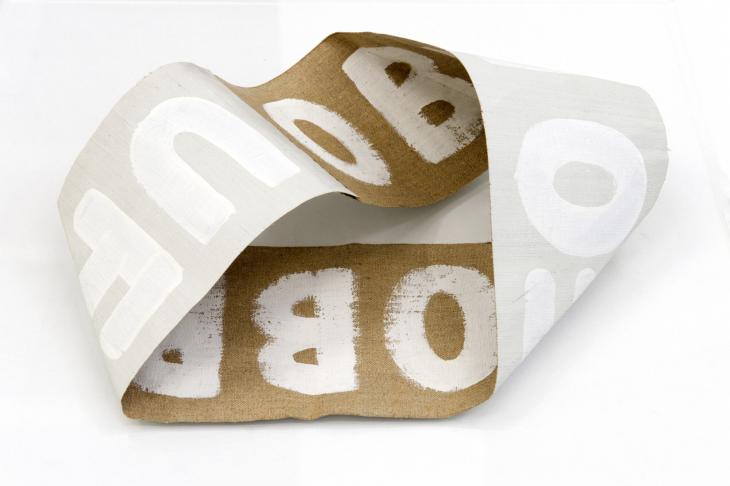
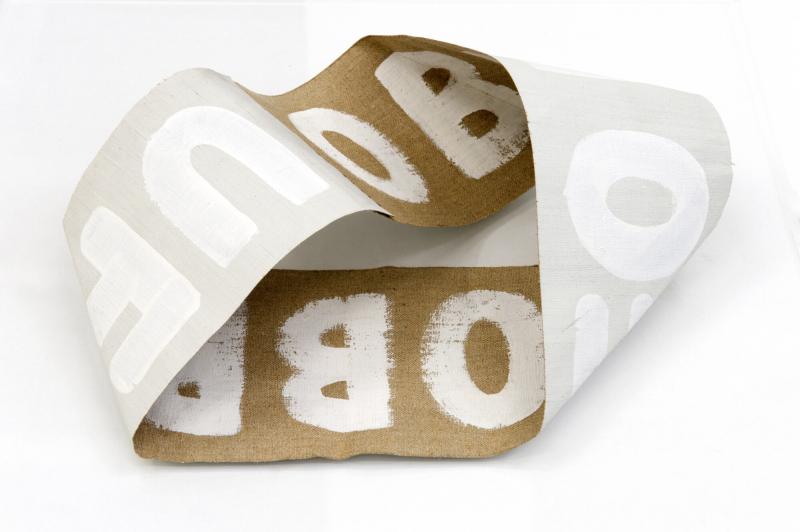
“U.F.O.-Picture” (1978) is made from a cut piece of canvas that was twisted and joined to form a Möbius strip. Koller had been producing “anti-paintings” since 1968, when he began using readymade textiles with various printed patterns on which he then painted words and symbols in white latex. The Möbius strip is one of the key universal communication signs in Koller’s work. It first appears in 1973 in his manually produced text cards, which he mailed as his form of participation in the international mail art network.
The strip’s two faces bear the terms “OBRAZ” (“picture”) and “U.F.O.,” both painted in white latex. These two concepts function as opposites, yet their texts appear to overlap and merge. The 1970s saw Koller create a large number of works in different sizes and formats using the motif of the Möbius strip, on whose opposite sides he would place various pairs of concepts and symbols: capitalism and socialism, + and –, up and down, life and death, ? and !, as well as others. The Möbius strip very often takes the shape of the Bermuda triangle, twisting at each corner. It delineates an asymmetrical, abstract, and tautological space. To Koller, it is a sign of infinite transformation and the unification of polarities in an ideologically divided world. D.G.
The strip’s two faces bear the terms “OBRAZ” (“picture”) and “U.F.O.,” both painted in white latex. These two concepts function as opposites, yet their texts appear to overlap and merge. The 1970s saw Koller create a large number of works in different sizes and formats using the motif of the Möbius strip, on whose opposite sides he would place various pairs of concepts and symbols: capitalism and socialism, + and –, up and down, life and death, ? and !, as well as others. The Möbius strip very often takes the shape of the Bermuda triangle, twisting at each corner. It delineates an asymmetrical, abstract, and tautological space. To Koller, it is a sign of infinite transformation and the unification of polarities in an ideologically divided world. D.G.