Autoportrét (Dialóg)
/1
- Selfportrait (Dialogue)
- Autoportrét (Dialóg)
- 1964/1966
- oil-paint and paper on cardboard and plywood
- 48,7 × 37,5 cm
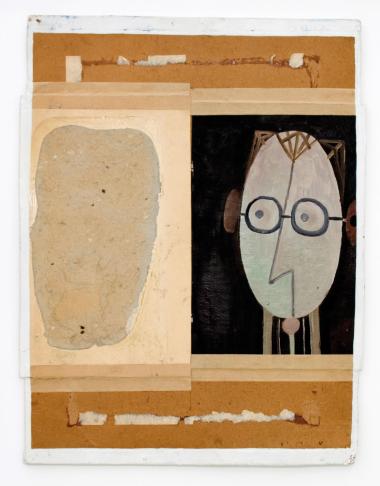
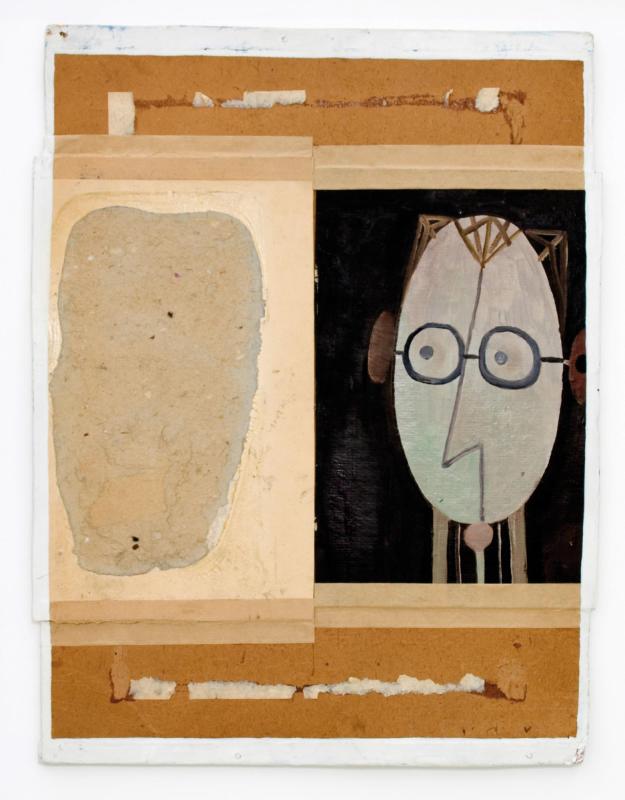
Július Koller’s “Autoportrét” is a key work from the early phase of his development and an important precursor to Slovak conceptual art. Instead of presenting a traditional likeness, Koller transforms the idea of the self-portrait into a visual sign system: the figure is reduced to a schematic image and accompanied by arrows and graphic elements that evoke communication, direction, and coded meaning. In this, Koller shifts attention away from physical appearance and toward questions of identity, language, and artistic subjectivity.
Created at a moment when the artist was moving beyond conventional painting, “Autoportrét” exhibits Dadaist influences but also reveals the artist’s growing interest in conceptual strategies and critical reflection on the function of art. The work combines painterly means with a diagrammatic structure, anticipating the anti-paintings, interventions, and “U.F.O.” projects that would come to define Koller’s practice later on. The self is presented not as a stable entity but as an open proposition, inviting viewers to participate in the construction of meaning. W.S.
Created at a moment when the artist was moving beyond conventional painting, “Autoportrét” exhibits Dadaist influences but also reveals the artist’s growing interest in conceptual strategies and critical reflection on the function of art. The work combines painterly means with a diagrammatic structure, anticipating the anti-paintings, interventions, and “U.F.O.” projects that would come to define Koller’s practice later on. The self is presented not as a stable entity but as an open proposition, inviting viewers to participate in the construction of meaning. W.S.